

What is an “ISI paper”?
ISI was the institute that built the citation index of scholarly journals; the index is now called Web of Science. An “ISI paper” means a paper in a journal in that index, not a paper in some special format. What indexed journals really ask for is these four things:
- The IMRaD structure: introduction, methods, results and discussion, with an abstract and a conclusion.
- The reporting checklist for the study design: CONSORT for trials, STROBE for observational studies, PRISMA for systematic reviews, CARE for case reports and others collected by the EQUATOR Network.
- The journal's citation style, such as APA, Vancouver or IEEE.
- That journal's guide for authors: word limits, the abstract's form, the number of figures and tables and the declarations it needs.
Why chatbots invent references
A language model doesn't search a database of papers; it writes text that looks likely. To it, a reference is a pattern of authors, a title, a journal and a year, so it can write one that looks exactly right and doesn't exist, or put a real title with another paper's DOI. Before you cite any reference:
- Open the DOI at doi.org and check it opens the same paper.
- Find a reference without a DOI by its title in Crossref or Google Scholar.
- Compare the authors, year and journal with the paper itself.
- Check that the paper hasn't been retracted.
Where AI is allowed, and where it isn't
The ICMJE and COPE recommendations, and most large publishers' policies, agree on the essentials: AI may help with the writing, but it isn't an author and its use must be declared.
- Allowed: shaping a draft, smoothing the language, writing sections from your own data and notes, formatting citations.
- Not allowed: making up data, results or references; listing AI as an author; and sending someone else's work as your own, whether a person or a tool wrote it.
- Always: declaring the use of AI, reading the whole text through, and answering for every sentence printed under your name.
From research material to a Word file in Goftito, step by step
-
The details
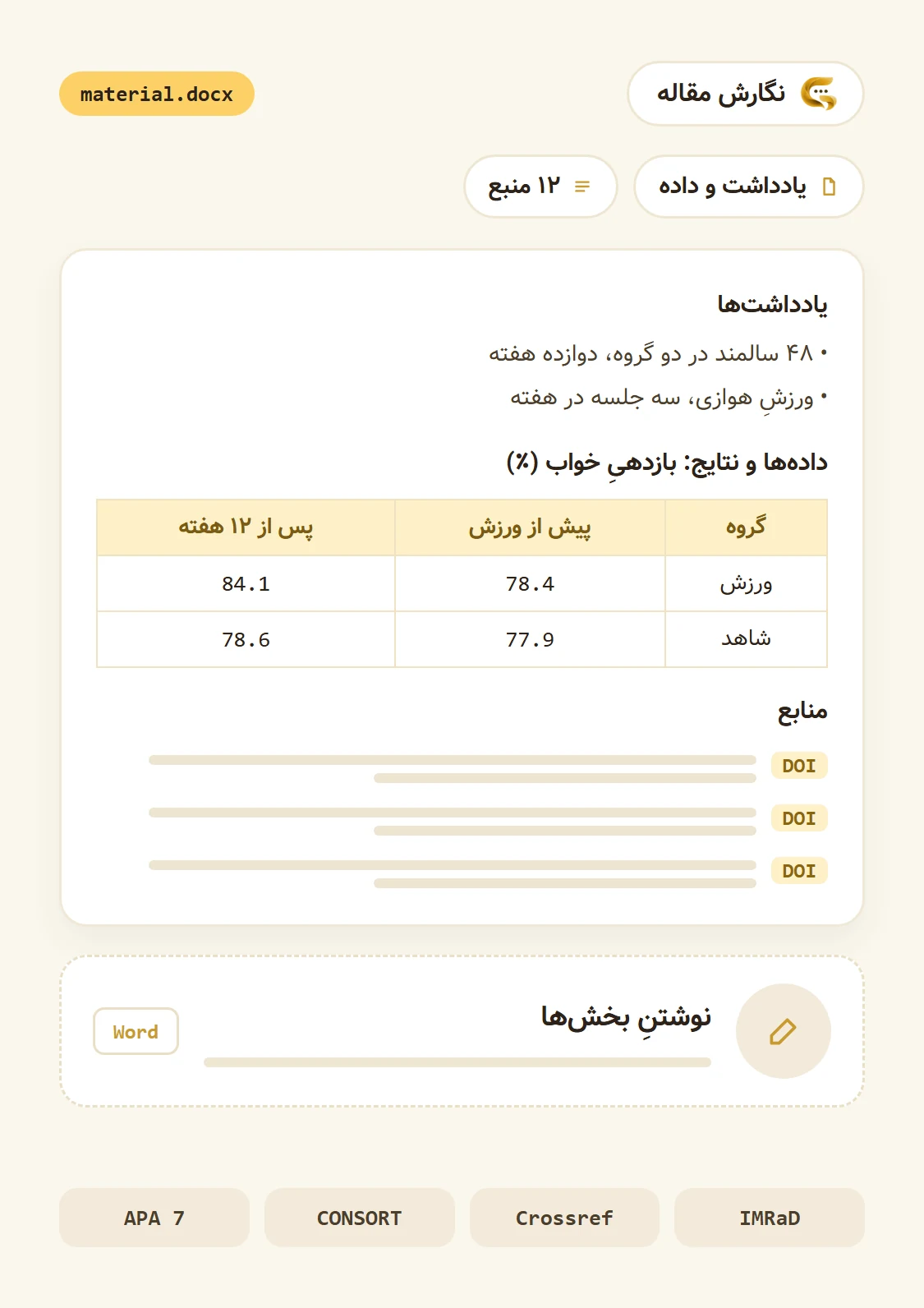
The article type, study design, language (English or Persian), citation style, target journal and its guide for authors, the authors and the declarations.
-
Your material
Your draft, data and results, notes and files (Word, PDF, CSV and text). The files' figures and tables are taken out, and you choose which go in the paper.
-
References
Paste DOIs, BibTeX, RIS or a reference list; each is found and verified in Crossref. Only verified references are cited.
-
The outline
The sections and their points are written; edit them before the writing.
-
Writing
Section by section, and the abstract last. Rewrite any section with your own instruction, or edit it by hand.
-
Checks and the file
See the checks and the checklist, fill the gaps and take the Word file: laid out like a published paper, or a submission copy with line numbers.
An example: a paragraph of results
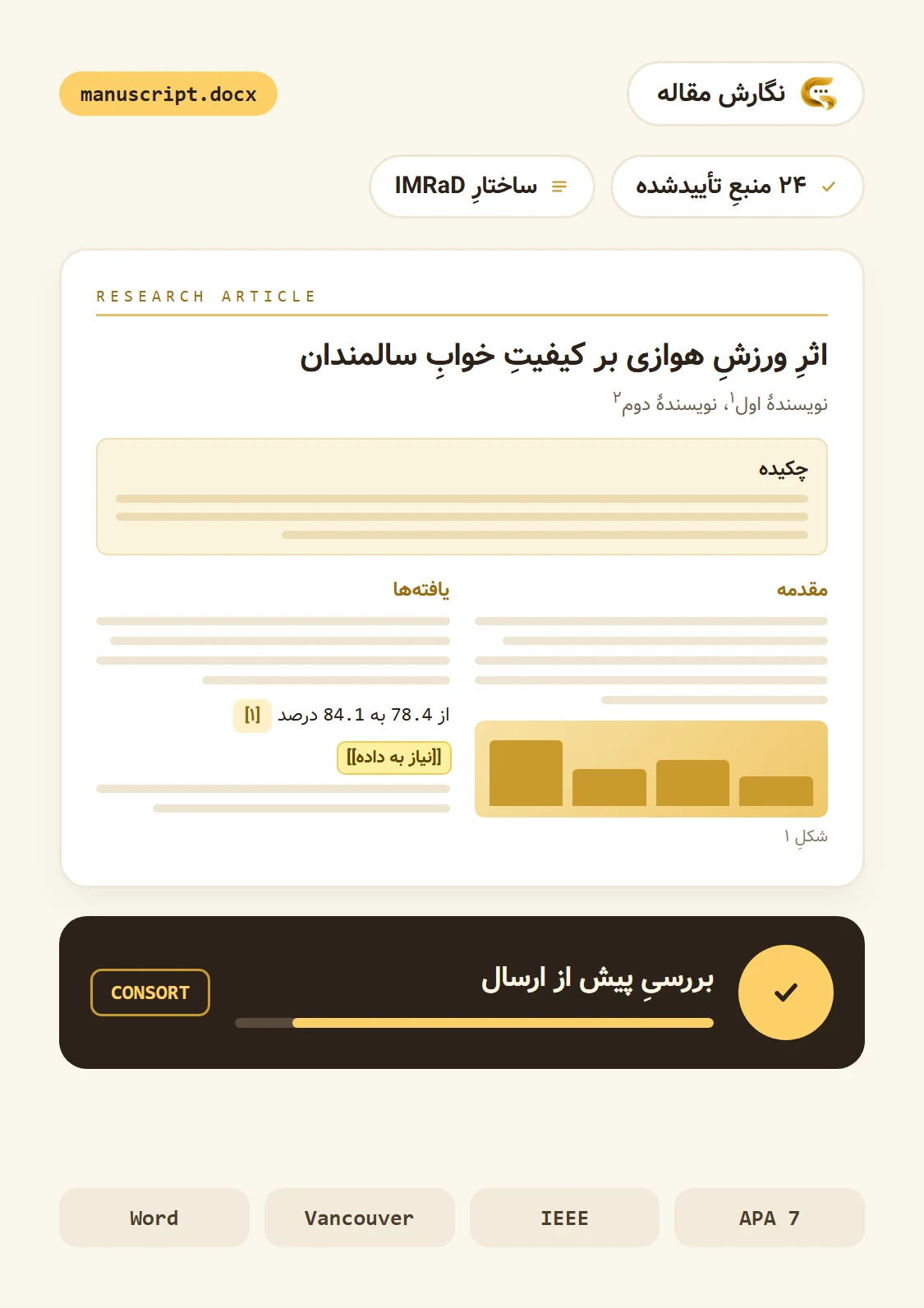
This paragraph was written to show the method; it isn't from a real study. Its figures come from the results table the researcher gave:
- Both figures are in the researcher's results table; no figure came from anywhere else.
- Reference [1] was found and verified in Crossref before it was cited, and numbered in the Vancouver style.
- A reviewer would want the drop-out rate but it wasn't in the material, so a gap was left, not a guess.
Before you submit
- Every reference has been found and verified, and none was retracted.
- Every figure and result in the text is in your own data.
- No “data needed” gap is left.
- The abstract, the text and the number of references are within the journal's limits.
- Every item of the reporting checklist is answered.
- Every figure and table is mentioned in the text, in order.
- Funding, conflicts of interest, ethics and data availability are stated.
- The use of AI is declared and every author has read the text.