

What from the thesis goes on the slides
The thesis says everything; the defense shows only what the committee needs to see. A session usually runs like this:
- The title, your name, the supervisor and the university.
- An outline of the parts.
- The problem and the aim: why this research was needed.
- The method: sample, data and tools, short and clear.
- The findings: the key figures and tables, each with one message.
- The conclusion, the contribution, the limits and next steps.
- Thanks.
Split the session's time
Ask your faculty how long the talk is; it's usually about twenty minutes for a master's and more for a PhD. About one slide a minute is enough, and give most of the time to the findings:
- Introduction and problem: about a fifth.
- Method: about a quarter.
- Findings: about a third.
- Conclusion and next steps: the rest.
In Goftito you set the session from 8 to 45 minutes and each slide gets its own time, adding up to those minutes.
Write the talk, then practise aloud
The slide is for the committee and the talk is for you. Have a few spoken sentences for each slide, not the thesis's written ones:
- Read the talk aloud and time it; reading silently is always shorter.
- Listen to the talk read aloud to learn its rhythm and where to pause.
- For each figure, say what it shows, not what it is.
- Learn the opening and the close by heart; carry the rest with the slides.
Get ready for the committee's questions
Most questions are about a few recurring subjects. Have a short answer for each, drawn from the thesis itself:
- Why this method and not another?
- How was the sample chosen, and how large was it?
- Where did the data come from, and how reliable is it?
- What were the work's limits?
- What does this research add to earlier work?
- What is the finding good for in practice?
Preparing in Goftito, step by step
-
Give the thesis
Open the “Defense session” tab under “Papers & Thesis” and give up to five Word, PDF or text files, plus the university logo. Figures and tables come across better from Word.
-
Length and questions
Choose the session's length, how many committee questions you want and the colour scheme, and see the cost estimate.
-
Read and edit
Read the slides, the talk and the questions and answers, and change whatever needs it; editing costs nothing.
-
Download and practise
Download the PowerPoint, the talk and the questions and answers, and make the talk's audio to practise with.
An example: one slide from the findings
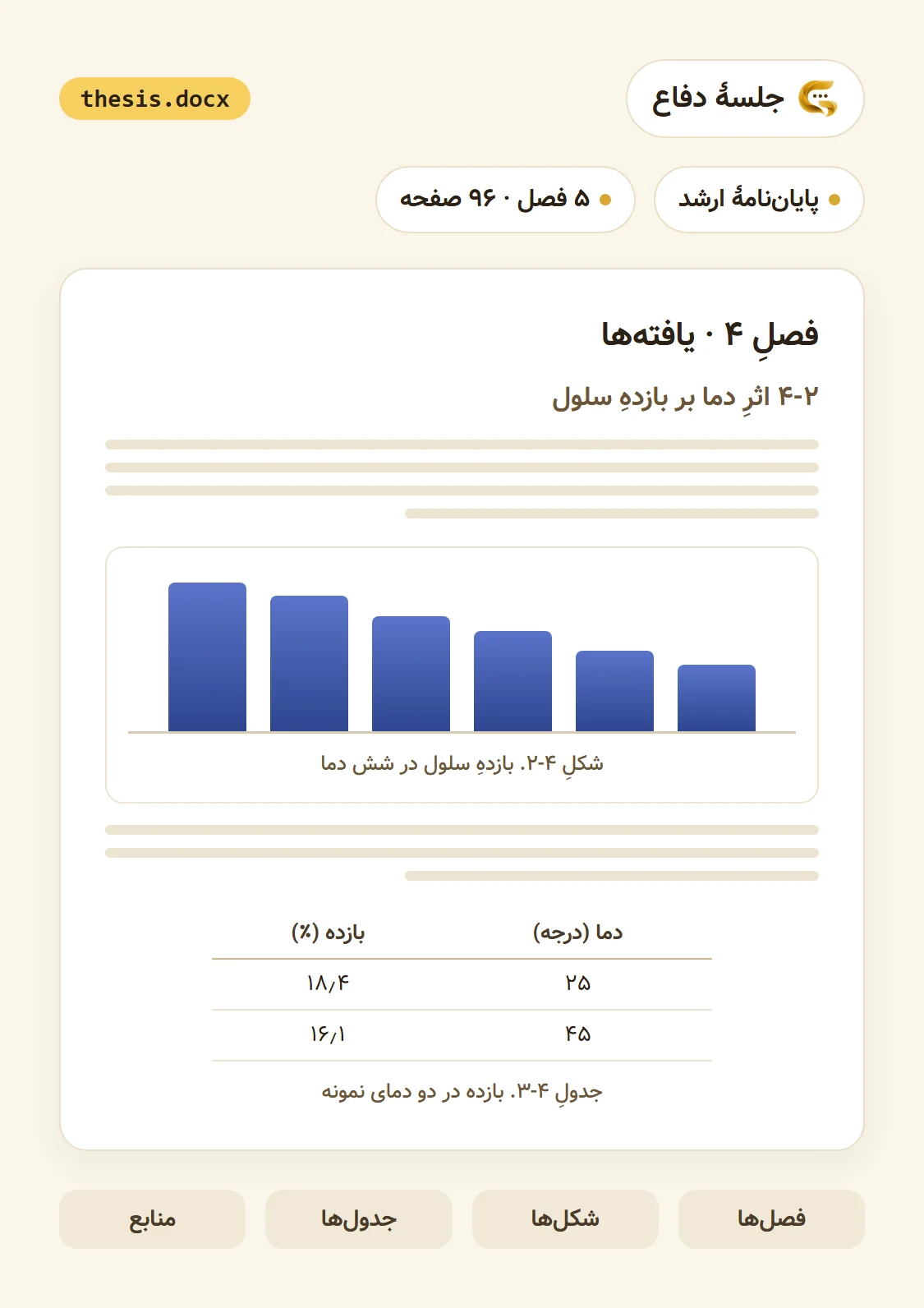
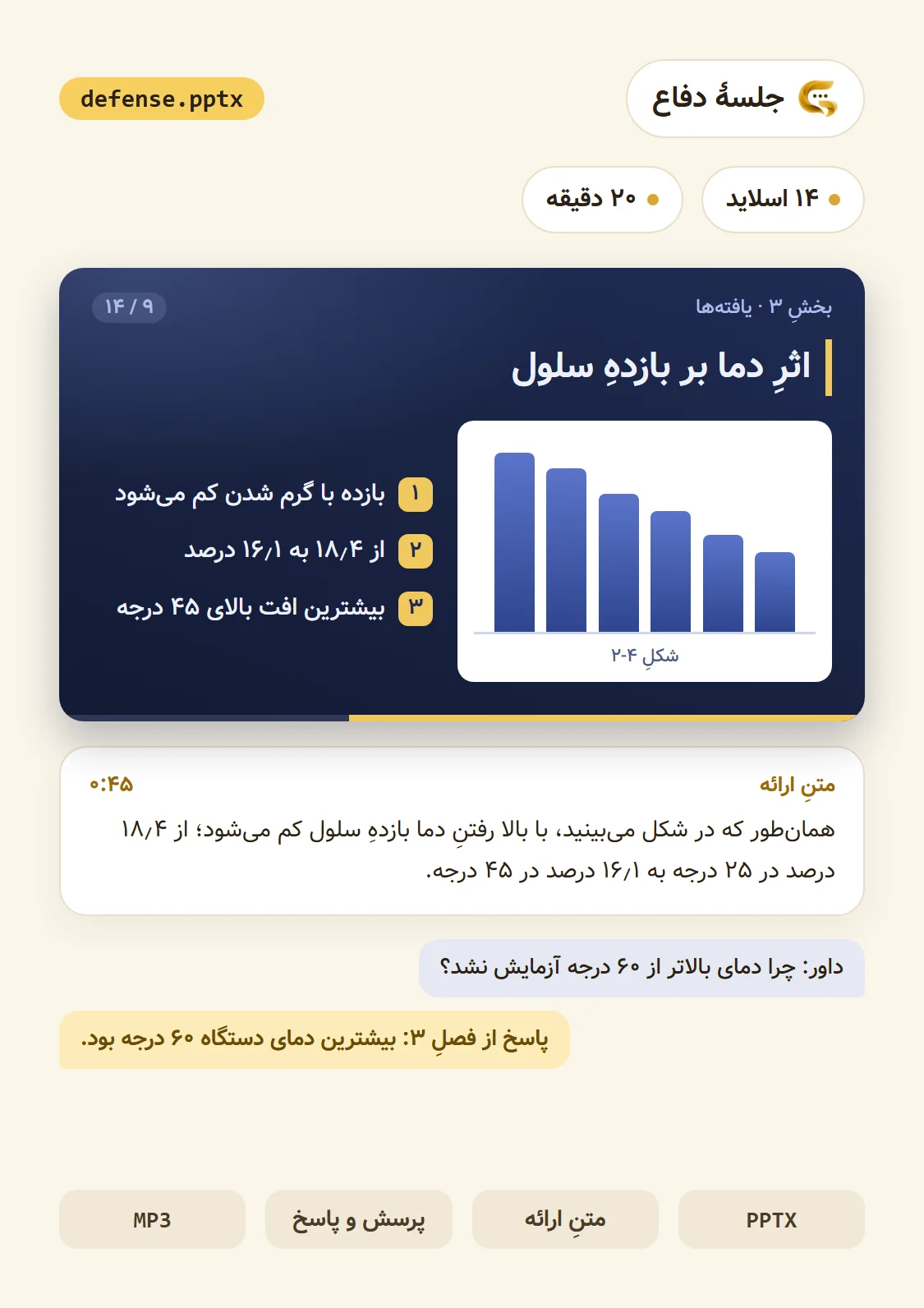
A page of the fourth chapter of a made-up thesis on solar cell efficiency, with one figure and one table. The slide made from it:
- Title: temperature and cell efficiency.
- Figure 4.2 as it is in the thesis.
- Three points: efficiency falls as it warms; from 18.4 to 16.1 per cent; the biggest drop above 45 degrees.
- The talk: forty-five seconds, with the table's own numbers.
- Examiner's question: why was nothing above 60 degrees tested? Answer from chapter three: the rig's top temperature was 60 degrees.
There is no number on the slide that isn't in the thesis, and the answer comes from the chapter that describes the method.